
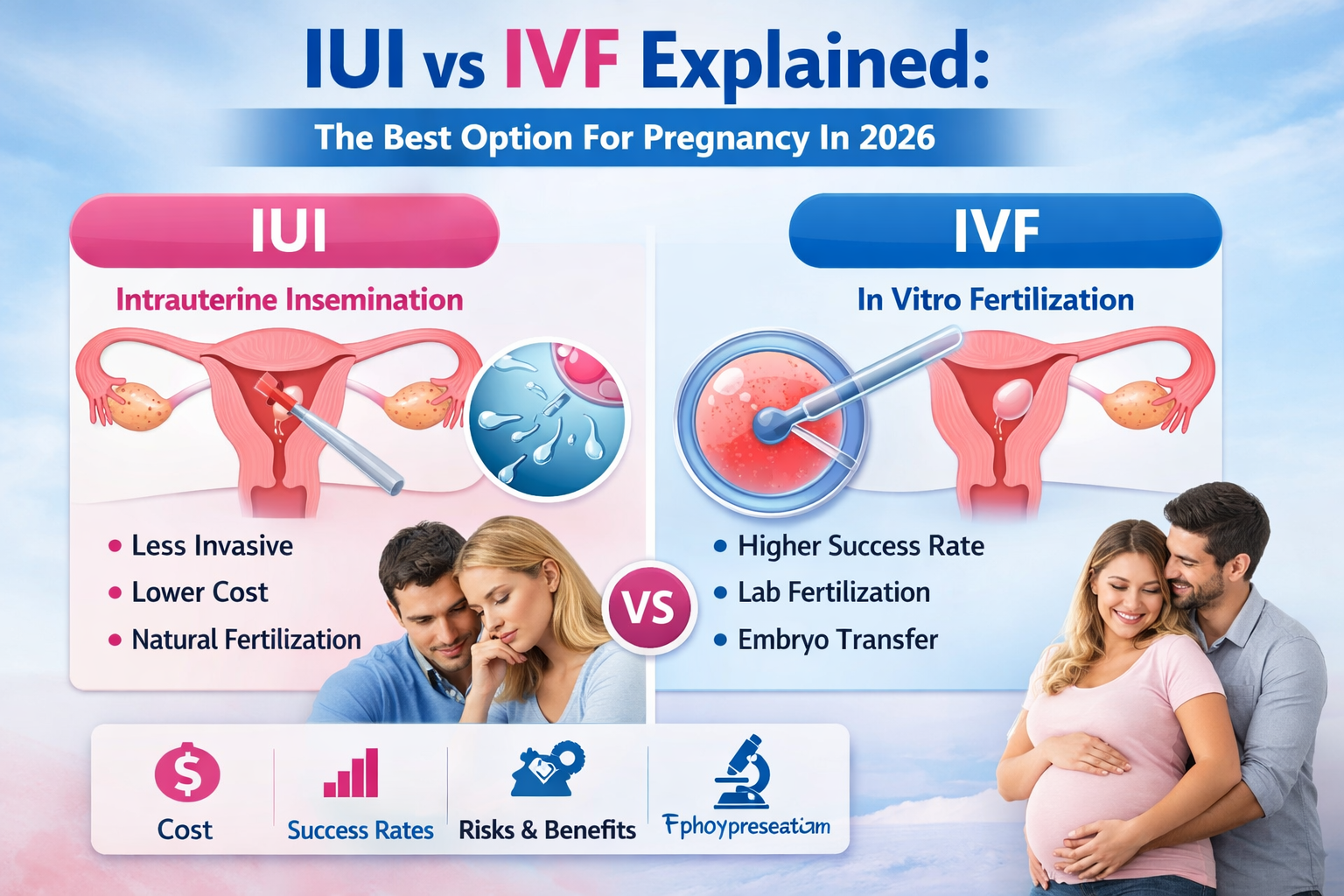
If you’re trying to get pregnant and your doctor has mentioned IUI or IVF, you’re probably feeling a mix of hope, fear, and a hundred questions at once.
You might be wondering:
- Which one works better?
- Is IVF too extreme?
- Should I try IUI first?
- What if I choose the wrong one and lose precious time?
You’re not alone. In 2026, fertility treatments are more common than ever before. Many couples begin their journey by consulting specialists at a trusted IUI and IVF clinic in Baner, Pune, where proper testing and guidance help them understand which treatment is best suited to their situation.
Modern fertility medicine offers real hope but choosing between IUI and IVF can still feel overwhelming. This guide will walk you through everything in a simple, honest, and supportive way so you can feel more confident about your next step toward parenthood.
Why So Many Couples Feel Confused About IUI and IVF
Fertility struggles don’t just affect the body, they affect the heart and mind too.
You might be dealing with:
- Family pressure
- Friends announcing pregnancies
- Monthly disappointment
- Doctor visits and test reports
- Fear of spending too much money
- Fear of losing time
On top of that, the internet is full of mixed information. Some people say IUI worked for them on the first try. Others say they wasted years before switching to IVF. Doctors may give different opinions based on your diagnosis, age, and medical history.
This is Where Confusion Begins:
- IUI sounds simple and less scary
- IVF sounds powerful but intense
- Both promise pregnancy
- Both cost money
- Both involve emotions
The truth is simple but important:
There is no single “best” treatment for everyone. The best option is the one that fits your body, your condition, and your timeline.
What Is IUI?
Think of IUI as giving nature a small push in the right direction. In natural pregnancy, sperm has to travel through the vagina, cervix, uterus, and into the fallopian tube to meet the egg. That’s a long and difficult journey. IUI shortens that journey by placing healthy sperm directly inside the uterus at the perfect time.
How IUI Actually Works
A typical IUI cycle looks like this:
- Ovulation tracking: Your doctor monitors your cycle using scans or medications to know exactly when you are about to ovulate.
- Sperm preparation: A semen sample is washed and concentrated so only the healthiest sperm are used.
- Insemination: The prepared sperm is gently placed into the uterus using a thin catheter.
- Waiting period: You go home the same day and wait about two weeks to see if pregnancy occurs.
The procedure usually takes only a few minutes and does not require anesthesia.
Who Is IUI Best For?
IUI is often recommended for:
- Couples with unexplained infertility
- Mild male factor infertility
- Ovulation problems like mild PCOS
- Cervical mucus issues
- Women using donor sperm
- Same-sex couples
- Couples with open fallopian tubes
Why Many Couples Prefer Starting With IUI
- It feels more natural
- It’s less invasive
- It’s simpler emotionally
- It costs less
- It doesn’t involve surgery
- Recovery is immediate
For many couples, IUI feels like a gentle first step rather than jumping straight into IVF.
Limitations of IUI
- Success rates are lower than IVF
- It won’t work if fallopian tubes are blocked
- It is less effective for women over 35
- It doesn’t fix severe sperm problems
- It may take multiple cycles
That’s why doctors don’t usually recommend unlimited IUI attempts.
IUI Success Rates by Age
| Age Group | Success Rate per Cycle |
|---|---|
| Under 35 | 10–20% |
| 35–40 | 8–12% |
| Over 40 | Under 5% |
These numbers show why IUI is often considered a starting option rather than a final solution.
What Is IVF?
IVF is a more advanced fertility treatment where fertilization happens outside the body in a laboratory.
Instead of hoping sperm and egg meet naturally inside the fallopian tube, doctors bring them together under controlled conditions. Then, the healthiest embryo is placed back into the uterus.
How IVF Works Step by Step
- Ovarian stimulation: Hormone injections stimulate your ovaries to produce multiple eggs.
- Egg retrieval: A minor procedure collects the eggs from the ovaries.
- Fertilization: Eggs are mixed with sperm in a lab or injected with sperm (ICSI).
- Embryo development: Fertilized eggs grow into embryos over 3–5 days.
- Embryo transfer: One or more embryos are placed into the uterus.
- Pregnancy test: After about two weeks, you test for pregnancy.
Who IVF Is Best For
- Fallopian tubes are blocked or damaged
- Severe male infertility exists
- Endometriosis is present
- You’ve had failed IUI cycles
- You are over 35
- Egg quality is low
- Genetic screening is needed
Why IVF Has Higher Success Rates
- Fertilization is controlled
- Weak embryos can be avoided
- Hormones are carefully managed
- Timing is exact
- Genetic screening can be done
- Embryos are selected carefully
This is why IVF is often chosen when time matters most.
IVF Success Rates by Age
| Age Group | Success Rate per Cycle |
|---|---|
| Under 35 | 40–55% |
| 35–40 | 30–40% |
| Over 40 | 10–20% |
Challenges of IVF
- Higher cost
- Daily hormone injections
- Emotional ups and downs
- More clinic visits
- Slight risk of multiple pregnancy
Still, for many couples, IVF becomes the best chance for parenthood.
IUI vs IVF: What’s the Real Difference?
Let’s make it very simple:
- IUI helps sperm meet egg naturally
- IVF creates embryos outside the body
- IUI is less expensive
- IVF is more effective
- IUI is easier physically
- IVF is more demanding emotionally
- IUI is often tried first
- IVF is used when stronger treatment is needed
In short:
- IUI is a gentle push.
- IVF is a scientific shortcut.
Success Rates in 2026: What’s Changed?
Fertility treatment has improved greatly by 2026:
- Better hormone medicines
- Improved lab environments
- AI-assisted embryo selection
- More accurate ovulation tracking
- Personalized treatment plans
IVF has benefited the most from these advances. IUI has improved too, but IVF still offers higher chances of success overall.
Cost Comparison: IUI vs IVF
IUI Cost
- Lower cost per cycle
- Medicines may add to cost
- Often requires multiple cycles
IVF Cost
- Higher upfront cost
- Includes lab fertilization
- Higher chance of pregnancy per cycle
Many couples realize IVF can be more cost-effective long-term if IUI fails repeatedly.
Which Treatment Is Right for You?
The choice depends on:
- Your age
- Your diagnosis
- Your hormone levels
- Sperm quality
- Fallopian tube health
- Emotional readiness
- Financial situation
General guidance:
- Young couples with mild problems → try IUI
- Tubal blockage → IVF
- Low sperm count → IVF
- Age over 35 → IVF
- Long infertility history → IVF
How Many IUI Cycles Should You Try?
Most doctors suggest:
- 2–3 cycles if under 35
- 1–2 cycles if over 35
If pregnancy doesn’t occur, IVF usually becomes the next step.
Side Effects and Risks
IUI Risks
- Mild cramping
- Slight infection risk
- Chance of twins if medicines are used
IVF Risks
- Injection discomfort
- Hormone side effects
- Emotional stress
- Ovarian hyperstimulation (rare)
- Multiple pregnancy
Modern safety standards have greatly reduced complications.
How Technology and AI Help in 2026
Fertility clinics now use:
- AI-based embryo grading
- Genetic testing
- Personalized hormone dosing
- Fertility prediction software
- Smart ovulation tools
These improvements increase pregnancy rates and reduce miscarriage risk.
Real-Life Scenarios
- A couple with mild infertility may succeed with IUI
- A woman aged 38 may succeed faster with IVF
- Low sperm count usually needs IVF
- Long infertility history favors IVF
Every fertility journey is different.
Frequently Asked Questions
Choosing Between IUI and IVF in 2026
There is no perfect answer for everyone.
- IUI is often the first step.
- IVF is often the strongest step.
What matters most is choosing what fits:
- Your body
- Your diagnosis
- Your emotional strength
- Your timeline
You are not weak for needing help.
You are not failing because it’s taking time.
You are doing something brave by searching for answers.
Take the Next Step
The best decision comes from medical testing and professional guidance. Talk to a fertility specialist, understand your options, and choose the path that gives you the highest chance of success.
Your road to parenthood may look different than you imagined—but it can still lead to the same beautiful destination.